
Thursday, February 15, 2018

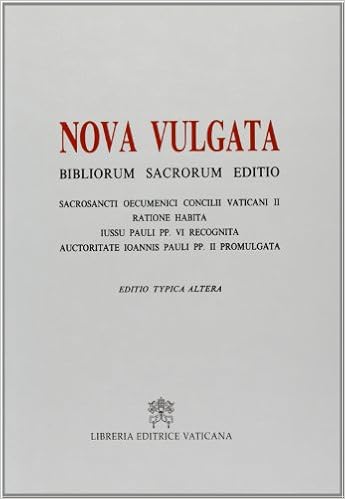
Don't read the Nova Vulgata

Image resultImage result for versusImage result for nova vulgata

It is possible to translate from a language you don't understand to a language you don't understand.  In fact, computers do this all the time and we all know how accurate Google Translate is (not very much).

But yes, if I had a Russian Arabic dictionary and a basic outline of Arabic and Russian grammar I could translate a text from Arabic to Russian even though I do not know either Arabic or Russian.  I wouldn't know what the text said or what it meant but I could render a possible translation of that text into Russian.

But would any of you rely on that translation for anything?  No, and it would be foolish to do so. Yet, this seems to be the exact process that happened when the Vatican created the Nova Vulgata.

Before the Nova Vulgata, there was the Vulgate of Saint Jerome.  There had been Latin translations of the bible before Jerome but they were produced by various people in various places at various times and from various sources, which of course all makes it sound like the outcome had various degrees of quality.

Then Jerome comes onto the scene.  He was first tasked with making a good translation of the New Testament from Greek to Latin and so he did so.  That translation was pretty good due to the fact that Jerome was a native speaker of both Greek and Latin.  He of course was not the only person with that status back then and his work was scrutinized and criticized by others which helped make Jerome's translation the best it could be. If there was a huge error in Jerome's work, the historical texts would tell us.

After the New Testament, Jerome moved onto the Psalms.  First he revised the Latin translations of the Psalms that already existed but this work was deemed not good enough. So then Jerome translated the Psalms again from the Greek Old Testament that Christians had been using since the time of Christ himself.  That translation was pretty good but while he was translating the Psalms, Jerome got an idea that maybe making a translation from a translation was not a good thing.  Maybe he should go and translate the Psalms from the original Hebrew.  Well, Jerome didn't speak Hebrew, so what was he going to do?

The answer for Jerome was to move to Bethlehem, learn to speak Hebrew by living his daily life speaking Hebrew.  He spent 20 years living with the Israelis, speaking Hebrew everyday and then he translated the Psalms again, from the original Hebrew.

By then the version of the Psalms that he'd made from the Greek was already popular and after a lot of people looked at this new work, they didn't see any obvious improvements that would entice them that the translation from Hebrew was better.  Jerome himself insisted it was better and to show them, he then translated most of the Old Testament from Hebrew instead of the Greek.

Now, today, we might wonder what a translation of the Old Testament from the Greek might have been like.  But alas, we never got that, at least not from Jerome.  What we got instead was a translation of the Old Testament from the original Hebrew after Jerome became fully fluent in the language.

But there was a problem.  Not all of the Old Testament was written in Hebrew.  Some of it was written in Greek, one small section in Latin, and several large parts in ... gasp ... Aramaic, the language of Christ himself.

At first, Jerome didn't want to bother with these parts, figuring that the Hebrew was what mattered.  He seemed to have adopted this idea that Hebrew was better than all other languages and the Aramaic of our Lord and Savior Jesus Christ was inferior.

Well the Church did not agree.  Languages are languages, it is the message that is important not the paper it is written on or the language it is written in.

Well, Jerome could do the Greek parts well enough (the Latin not needing to be translated) but what could he do about the Aramaic?  Should he translate from the Greek translation?  Jerome decided not to. He found a helper who knew both Aramaic and Hebrew and another helper who knew both Aramaic and Greek. With their help, he got close enough to understanding what the Aramaic said to render a very good Latin translation with the caveat that he was translating sense for sense not word for word.

Those translations were accepted and the Latin Vulgate was formed consisting of a New Testament translated from the original Greek to Latin, the original Hebrew to Latin, and the original Aramaic to Latin through cross reference, double checking, and due diligence.

Jerome wanted his Psalms translated from Hebrew to be the ones that were used. They were not. Instead, his decades earlier translation from Greek was retained and even today, when put under examination, that translation holds up as the superior version.

In every age, again and again, people looked back over Jerome's work because in the story of how Jerome translated the Bible there is the little inkling of something that nags at us.  Why didn't he translate the Old Testament from the Greek?  Why are we using the a translation from Greek for the Psalms instead of the Hebrew?  Why did he not like the language that Jesus himself spoke?  All of this causes suspicions that perhaps Jerome was not as pious as we would have liked and further that this allowed some corruption to enter into the text.

So time and again people have gone back over Jerome's work and scrutinized it.  In fact, this started when he was still alive and even after Jerome was declared a saint and his work had the official stamp of approval from pope after pope, that scrutiny continued.  It is as if every generation refuses to just be told that Jerome's translation is the best one and they have to go behind the Church and check it and come to that understanding themselves.  It is akin to how someone studying Latin gets good enough to start to be able to read the text for the liturgy and they begin to feel that maybe the Mass of Paul VI is invalid. So they learn more and double check until they eventually come to the realization that the Mass of Paul VI is good enough to be valid (if only just barely).

For Catholics, a document having the official Vatican stamp of approval was never the ultimate criteria for us to consider something good enough for our faith.  Christ is the standard and we are always trying to make sure the Church is good enough.

So over the centuries, Jerome's work has been checked and double checked and argued over.  The work had to again and again reaffirm its place as the best Latin version of the Bible.  Over time, new translations of the Bible into Latin were created but none were as good as Jerome's and that had nothing to do with the Vatican giving Jerome's work its stamp of approval.  Even as recently as Pius XII, they tried to change the Psalms to a newer translation but it didn't take off.  When compared side by side with Jerome's work, Jerome wins out every time with the lone exception of Psalm 94 where an unnamed translator from the age before Jerome created the version that even Jerome could not match and so that lone Psalm is included in the Latin translation though it was not from Jerome.

Now, compare that storied history of the Latin Vulgate to the Nova Vulgata, the current translation that has the Vatican's stamp of approval.

The men who created the Nova Vulgata did not speak Greek. They did not speak Hebrew. They did not speak Aramaic. They did not even speak Latin. They were 'scholars' who had university degrees in these subjects they way I have a university degree in Political Science which I do not use.

More over, they were not using the original source texts of the Bible in the original languages to create the Nova Vulgata even though that was what the Pope told them to do. They defied the Pope's instructions and did not use the original Greek of the New Testament that has been safely guarded by the Catholic Church. They did not even use the version of the New Testament that the Melkite Church uses.  They did not even use the version of the New Testament that the Greek Orthodox Church uses.  No. They instead decided to use an edited and shorter version of the New Testament that protestants use.  PROTESTANTS.

But so what if protestants supplied the text so long as it is the correct text, right?  Sure, but it's not the correct text.  The protestants edited the text and cut out words or even verses that they didn't like.

So why would Catholic scholars who are charged with making a Latin translation of the Bible use a protestant edit?  Follow the money.  The Bible Society that supplied the text gave a large sum of money to several of the scholars, not all of whom were Catholic.  The scholars then decided to use the protestant Bible Society's text of the Bible, old and new testaments.  Then, since the new translations is a derivative of the Bible Society's version that is under copyright and not the ancient original version which is in the public domain, every time the Vatican sells a copy of the Nova Vulgata or uses the verses in the Nova Vulgata for the Missale Romanum or the Divine Office; the Church has to pay a royalty to the protestant Bible Society.  The Nova Vulgata is a scam to funnel money away from Catholics and give it to protestants.

Of course, paying would not be so bad if the Nova Vulgata was an acceptable translations, but it's not.  It is evident on ever page, indeed, every LINE of the Nova Vulgata that the translators did not fully understand the Greek or Hebrew texts and weren't good enough with Latin to actually write a proper Latin sentence.  Reading through the Nova Vulgata I'm often struck with the thought that even I, David Billiot, could have done better.  There are so many errors, one after another.  Leaving words out, misspellings, grammar mistakes, using the wrong word, many times just typing the letters in the wrong order.  I want to pull my hair out.

The men writing the Nova Vulgata were not Latin native speakers. They were not Greek native speakers, nor Hebrew, nor Aramaic. They were guys who had a grammar book and some dictionaries and they were making a translations.  That translations into Latin has so many grammatical, lexical, and typographical errors in it as to render it USELESS. It's like they were children who found their father's gun and didn't know what it was or how to use it. Add on top of that the fact that protestants are stealing our money every time the Church prints off another copy of the Nova Vulgata and laughing all the way to the bank.

But if you try to express this knowledge to the Church hierarchy they don't want to hear it. Just use the English, they say, though they don't say which of the many, many English translations to use.  They say the Nova Vulgata is here to stay and they won't entertain any criticism of it.  But the Nova Vulgata won't stand the test of time the way Jerome's work has.  Even before the Nova Vulgata was finished being published, people who actually know Latin and actually SPEAK Latin started to make it known that this work was very sub par.  It is telling that the original plan for the Nova Vulgata was to only publish the sixty six books book the protestants could supply them with and not the full seventy three books of the bible.  They backtracked on that and found a way to mangle the remaining seven books as well, even spelling the name of Tobit wrong in a few places.  After all, it's not like the very book he appears in has his name as the title. Oh, wait, it does.

So in conclusion, don't use the Nova Vulgata unless you'd be fine letting your life depend on a translations that I could make from Arabic to Russian.  Don't let the Vatican's stamp of approval fool you.  If you want the Bible in Latin, get the Vulgate.  The Clementine Vulgate is the best one I know of and is the closest to what we know Jerome himself wrote. As for me, I trust the work of someone who had to defend his work and who was a native speaker or at least fluent in the languages he was using.  Language translation is not a math problem where you plug in some numbers and get an answer.  You have to know what you're saying and the people who made the Nova Vulgata did not.

The Pope should hold the line with China

The Pope is negotiating with the communists in China.  This is a bad thing.

For the record, I do not consider the communist government in China a legitimate government. The Republic of China, which is currently operating in Taiwan, which is legally still part of Japan; is the one and only true government of China.  I also do not consider Tibet to be a legitimate part of China, nor the South China sea (which shouldn't be called that).

The current communist dictator in China is Xi Jinping. Last year there was a scandal where it was revealed that this man is a pedophile who raped young children under the age of six at a day care center.  With all the accusations of sexual abuse launched at Catholics all the time, this is the last person on the planet any Catholic should be speaking to.

But anyway, we'll put my political view of China aside and we'll assume that the leaders in the Catholic Church just happen to not know that Xi Jinping does those kinds of things.  He murders people too so maybe they just figure that's par for the course. He also likes to dine at a restaurant that serves up the cooked remains of aborted babies as a delicacy so maybe sexually abusing children is actually one of this man's lessor crimes.

So all that aside, when we look at what's going on with the Vatican and China we are left with the conclusion that if you want the Vatican to do something your way, you just have to bribe them. That's all the communists had to do to get the Vatican to change their mind about the legitimacy of ordinations.

If you don't know, the situation inside communist controlled China is this; there are real bishops who have been legitimately ordained and thus are actual successors to the apostles.  There are also seven fake bishops who were not legitimately ordained.  They were simply summoned to Xi Jinping's office and informed that they were now bishops with no laying on of hands involved.  So from the perspective of the Church, they are actually just laymen pretending to be bishops the same way an Anglican 'bishop' is a layman pretending to be a bishop.  But the Vatican has recently said that even Anglicans who know they aren't really bishops can in fact be called bishops so I guess they feel there's not a big difference with these Chinese communists.

Anyway, for a long time the Church correctly said that these communists, none of whom believe in the existence of God or the historical fact of Jesus, were not in fact bishops and could not be considered legitimate. That should have been the end of the conversation.  They were no more a bishop than I am and I even have an advantage over them, l'm baptized and confirmed.

But the communists really want to get their hooks into the church and and they see Francis as a weak Pope so they see an opportunity there. They saw how Francis dealt with the Knights of Malta and they saw an opening to just bribe someone close to Francis and then get their way.  So that's what they did.  Wow, for all of this pope's calling for a poor church for the poor, it sure seems that a lot of the people around him are becoming millionaires overnight on a frequent basis.  Hey, maybe all we really need to get a new Sui Juris that exclusively uses the Extraordinary Form of the Latin Rite is to throw money at the problem; money which of course most traditionalist don't have because, you know, they're poor.

Now the situation in China is going to unfold like this, the current legitimate bishops will 'retire' and either go to prison in China or be exiled.  Then the fake bishops will take their place, ensuring that all future ordinations of priests and all future sacraments in China are null and void.  There will essentially be no legitimately ordained hierarchy in China. The Vatican is giving up on the future of China so one of the pope's buddies can buy a new mansion and a yacht.

"Yes, those poor Christians in China. So sad.  Hey, what color should I get for the leather seats in my new private jet?"


Saturday, December 16, 2017

I review Star Wars The Last Jedi (as if anyone cared)

Star Wars The Last Jedi.jpg

Unlike the previous film, The Force Awakens, where I had actually decided to never see it but ended up being paid to see it; I was not paid to see The Last Jedi. However, I didn't pay to see it either. 

I have actually now seen the film twice, both times for free. The first time was in a Japanese language theater so I could only understand about half of the film. There was no jack for English audio for my headphones in that theater.  I was actually very upset at this since I felt like they were wasting my time.  Under such circumstances, I would have liked to have been paid, preferably up front. 

I was invited to come see the film again at a different theater and this one had English audio and Japanese subtitles. 

How was it that I was able to see the film for free, twice no less, while not being paid to see it and not being paid to publish my thoughts on it?  OOH, a mystery. 

Anyway, I do have some thoughts on the film.  I did like it more than The Force Awakens.  However, whereas I disliked almost everything in The Force Awakens, I was only able to dislike about half of this film. 

Right off, I have to say that Carrie Fisher gave a MUCH better performance in his film than she did in The Force Awakens.  However, where as Fishers acting was much better, Leia's commanding was terrible.  What a bad leader. No wonder the resistance is about to be wiped out.  There is a Leia replacement during part of the film and that woman is awful in both her command and her acting.  So Po, a good character with a good actor playing him, has to share screen time with a bad actor who makes no sense as a character. 

It sort of goes that way for the whole movie. Every scene has a good actor and a bad actor.  A good character that makes sense and a bad character that never should have been in the movie.  Fin goes to do a thing but instead of going alone like he should have, he has to take Rose with him and she drags him and that whole plot line down.  Ren is doing well in his story but then Hux comes in and ruins the scene.  Luke is awesome on his island but then Rey is this annoying brat who doesn't deserve either a lightsaber or Fin's affections. 

Let's be clear, the film isn't all bad, just half bad.  For every positive thing I could say about the film, there is an equal and opposite thing that is terrible.  New force powers are shown in action and they don't need to be explained.  That's great. That feels like Star Wars.  Rose giving us SJW exposition is not great and doesn't belong in a Star Wars film. 

One thing that was amazing in the film was when Luke told Rey, the Jedi don't own the force.  That was so very Star Wars.  The Force is again for everyone and I can at least say I am thankful for that.  now there should be NOTHING stopping Fin from getting his hands on some of those Jedi books that Rey swiped from Luke, and unlocking his inner Jedi the way IT WAS SUPPOSED TO HAVE BEEN FROM THE START!!

I will say this, The Last Jedi is a much more honest film than The Force Awakens.  No more mystery about Rey's parents. They were just trailer trash.  But even if they weren't, there was no reason to make it a mystery like they were going to be important later.  The Force Awakens was a dishonest film and anyone with two brain cells should have been able to see that. 

So as of right now, we have it set up where Rey will be the Jedi and Ren will be the bad guy and they will have their final show down in the next film.  Fine, but I likely won't see the next film.  The Last Jedi does feel like the last Star Wars film I will ever see.  I no longer care about the rebels now that I've seen how their commanders behave.  We know the First Order is doomed.  The only thing that might get me to see the next Star Wars film would be if Fin finally became a Jedi. Let Rey teach him if they have to insist on her being a Jedi. Fine. But let Fin be a Jedi.  Without that, I'm really not interested in another Star Wars outing. 

But they aren't going to do that. I only hope, for the sake of the audience that will watch the next Star Wars, that they finally make Rey interesting.  They probably won't but even if they do, I'm not watching unless Fin becomes a Jedi sans midiclorians. 

Wednesday, October 11, 2017

Blade Runner, Gender and You

Do you remember that guy you used to know who was always watching Blade Runner and would talk about how it was one of his favorite films? Do you remember how much you wished that the guy and those like him would just shut up about a film that no one understood and would put even the people who claim to like it to sleep? That guy was me. So it’s very strange now that suddenly I find out that I in fact was apparently not the only person in the world who liked Blade Runner. Suddenly, liking Blade Runner is a cool thing now. Weird.

But I didn’t just like Blade Runner. I read the original book (actually a short story by my definition) that it was based on. I also read the novels that were the only things that were ever going to be sequels because we were all sure that no filmed sequel would ever be made.

Then Trump gets elected president and all bets are off. Anything can happen. We have an entire world of possibilities before us and low and behold, we got a Blade Runner sequel. SCORE!

Now, having watched the new film I can say a few things very clearly. First, I liked it. It’s at least as good as the original, but in different ways. The new film made me rear back in my seat with dread and agony. It is rare indeed that a film will elicit that kind of emotional reaction from me. Some of the scenes remind me a lot of the truck scene from the novels. They’re bleak and filled with despair. We feel the new agent’s isolation, alienation, and longing for affection. He could go and either buy or extort physical affection but he would know deep down that it wouldn’t be real. The closest he gets to someone actually caring about him is his fake computer girlfriend who he can’t physically touch. He can only see and hear her. It’s as haunting as the original in this aspect so we understand him when he goes out on a limb in an effort to get some kind of genuine human connection.

Second, I know that this was not a film that I would have written. There is a huge plot twist that we are informed of almost right at the very beginning of the film. Once we see that, most of the rest of the plot is predictable. But we still watch in morbid fascination and horror thinking to ourselves that the film makers aren’t really going to pull this on us. But they do and beat by beat we know what’s going to happen, we just haven’t seen how exactly yet. Knowing myself as a writer, I know I would have never felt confidence in this kind of story. I would never think it would work and yet here it does. The B plot from the first film has become the driving force of the A plot of this film and that is just so macabre that I can’t look away.

If I had written the film, I would certainly have a new blade runner meet Deckard. Why not? However, I would have never made his relationship with Rachael a pivotal plot point. No way. I might hint things in the background but I would never allow it to come up. I would be far more interested in having the new agent asking Deckard about a different case he was involved with before the events of Blade Runner. I would leave Rachael’s fate completely unanswered, maybe even with a hint that Deckard has her still alive and well stashed away somewhere. Or I’d pull some epic dramatic irony where the audience would be able to figure certain things out but the characters in the story would have no way to come to that conclusion.

Now, I do have one huge criticism of the film and it revolves around the question of whether Deckard is a replicant or not. For the record, according to the original short story, most cuts of the film, Harrison Ford the actor, and the sequel novels; it is firmly established that Deckard is one hundred percent human. However, it is intellectually interesting to watch the cuts that slightly suggest that perhaps Deckard is not human and ponder the question. That said, no matter if Deckard is or is not a replicant, it would not change the story of the first film. It is still Deckard’s personal story and it matters to him. The meaning of the film does not change regardless of the outcome of the question.

The original Blade Runner shares a kind of connection to Shakespeare’s Othello. Just as in the play, the title character is not actually our protagonist. In the play, Iago is the protagonist, carefully orchestrating his betrayal. In Blade Runner, Roy Batty is the protagonist, as he inches closer and closer to his goal of meeting Tyrell and maybe getting the chance to extend his life. Roy is the good guy in the film and Deckard is actually the unwitting villain. The big moment in the film is when Deckard finally realizes that he is the bad guy. It messes with our expectations and forces the audience to think outside the box. But that still isn’t the biggest issue that Blade Runner ask us to tackle inside of ourselves.

When that meeting does happen between Roy and Tyrell, if you listen closely, the word virus comes up several times. That wouldn’t seem to make much sense unless the Tyrell corporation was using viral DNA to make the replicants in the first place. If this is the case, then not only are the replicants not human, they aren’t even alive. They aren’t related to anything on the tree of life. They are simply robots made with biological components instead of mechanical ones. They are the other, a true other. That’s scary. Other films have asked us to look at this kind of issue before, when Superman and Lois Lane or Alien Nation but never to this extreme. Some may feel like this kind of drama is diminished if it turns out that Deckard is a replicant but Deckard doesn’t know he is one if in fact that is even true. The audience is still faced with the same question of these things that are made from a virus walking among us and we can’t tell the difference between them and us. In the old film, it would make absolutely zero impact on the story if Deckard is or is not a replicant which is why he almost certainly is not a replicant.

In the new film, however, the issue of Deckard being a replicant or a human is vitally important. It changes everything. If Deckard is a human than it means that all the replicants are human. They aren’t machines at all no matter how many mechanical parts or how much genetic engineering went into making them. If Deckard is human, then we’re dealing with humans again repressing members of their own race and finding a flimsy justification for doing so. We’re no longer talking about the other, but rather our own kind. The same moral issues that are raised in films like Gattica are now at play in Blade Runner. We’re dealing with cloning and designer babies, not a product assembled in a factory.

One of the things about the civil rights movement that a lot of people still need to wrap their heads around is the fact that black people are … wait for it …. people. They are human beings and our fellow citizens. Black people were never an other. They were always part of us. People kept trying to grapple with civil rights as if we were talking about an alien species that had invaded and wouldn’t go away, but that was never the case. Black people and white people were always all in this together from the word go and we were only deluding ourselves into thinking there was a difference. There is no need for black people and white people to have to learn to coexist with each other since we are already one nation, with the same humanity and equal in dignity. That is why the original Blade Runner is not a film about civil rights and it actually smacks of racism to bring that argument up. In the new film, if Deckard is a human, then the scary other of the first film is taken away and we are confronted simply with accepting our own.

However, if Deckard is a replicant then the internal meaning of this new story changes. We are confronted with the idea that humans are dying out and will eventually be replaced by viral automatons that simply resemble humans. It raises the question of how do we deal with the other who is not us and never will be us. Do we treat replicants like toasters or do we afford them at least the same legal protections that animals have? Because they are sentient, do we treat them as we might also treat a population of Neanderthals if we were to happen to find one still in existence? If we are able to decode dolphin language and can talk to them, does that mean they now gain the right to vote? Also, how deep and how complicated is the hinted symbiotic relationship between humans and replicants? Why do we only get told about so few models of replicants when the previous film made them out to be as numerous in model numbers as Android phones? Deckard, a seasoned Blade Runner, even has to be briefed on the four year life span of the new Nexus 6, implying that other models by other makers or previous Tyrell models had a longer life span. Maybe even an endless one. How do humans relate to beings that can outlive them or to beings that live a third of the life span of our dogs?
If the replicants are in fact an other, then for the first time humans will have to learn to live side by side with non humans that are at least as intelligent as us. The replicants are not us and will never be us. The more resources they use, it means fewer resources for the humans that are left. If humans are on the path to dying out, then it raises the question of whether the replicants would be able to take over society and keep the factories producing new replicants or not. If the humans are to die, then perhaps the humans wouldn’t want to leave the replicants behind to fend for themselves. Maybe we’d kill them all off, just to be sure.

In the new film, Deckard’s humanity isn’t an asset to the film, but a detriment. The replicants are human just as Deckard is most probably human because one of the replicants is shown to have DNA that can pass for human DNA and not be spotted. This means that the replicants are human and the messages that we are confronted with in the first film fall away and Blade Runner 2049 turns into just another civil rights metaphor.

So does the film have no value besides purely just entertainment? It is a film after all and entertainment is the purpose so there’s nothing wrong with that. But maybe we can draw deeper meaning if we examine the symbiotic relationship that the replicants and the humans have. Are there no two groups of humans that are in fact fundamentally different? There are.

In many ways, the human and replicant dichotomy is an excellent lens through which we can examine gender roles. It’s not a perfect metaphor but it is an argument that can be made and explored if there is the will to do it. The replicants can not exist without humans to create them, just as a man can not exist without a woman to be his mother. Similarly, the humans need the replicants as slave labor in a similar fashion that many women require a man to financially support her, without which she would be incapable of taking care of herself without hardship. Just as the replicants, being the slave labor, are seen as disposable, so too are men in modern society seen as disposable by many women who advocate for a maleless society while enjoying the shelter of buildings built by men and the freedoms that male soldiers died to protect. In the film, fatherhood is devalued and we witness a father never being allowed to see his child because it would bring danger. The humans see replicants as their created play things that can be abused at will the same way modern women see their sons as things to be taught to hate their maleness as it is a threat to the feminist establishment. We even see Wallace, a stand in for a mother, essentially castrating one of the new replicants, a stand in for a baby boy, in order to prevent the child from developing in ways that the mother doesn’t approve of. With increasing fervor we hear of women advising other women to abort male children in favor of having girls, or to encourage their daughters that the sky is the limit and discourage their sons from seeking their own male identity. We even hear stories of feminists sexually abusing their male children and using the ever nebulous rape culture as justification for child molestation.

The fact of the matter is, most women do not want a dangerous job that could lead to bodily injury, a decreased life expectancy, or instant death no matter how much the world needs that work to be done. And sure, most men probably don’t want those kinds of jobs either if given another valid choice but many men are not. While most women would never consider a career that might get them killed no matter what the pay happens to be, they will at the same time be perfectly happy to spend their boyfriends cash while he is off risking his life at a job that he only took so that he’d be able to afford the things that she demanded of him. And if he dies, she’ll morn, as it would look bad on her should she not do so, but then she’s on the prowl for the next disposable nonfemale to leech off of.

If you think this line of thinking is a stretch, remember, this is science fiction. One of the hallmarks of science fiction is to recast the players of human drama in different roles, put the shoe on the other foot as it were so that we can see the issues more clearly. Think of the Star Trek episode with the guy having one side of his face being white and the other side black. We use scifi to take issues that are too close to us to be able to see clearly, forest for the trees as it were, and we can pull away to see the big picture and gain greater insight. The fact is, men don’t know what it’s like to be a woman. We have no idea. Similarly, women don’t know what it’s like to be a man. Because of this, we’re always each fighting for our own positions without having sufficient information to understand where the other is coming from. By casting the humans as women and the replicants as men in modern society, we can see that the humans stay home and do no work while the replicants are forced to carry out menial tasks or even orders to kill each other for the benefit of the humans. When we see the underground cell of defiant replicants, we can imagine that they must feel the way many men’s rights activists must feel when trying to raise issues of domestic violence against men, financial devastation caused by divorce, child custody, and drought of affection.

If we see the replicants as men, we can understand their loneliness, their fatalism, their want for belonging. We see them desiring a normal family life with love and recognition and society preying on that desire while also cheapening it and ridiculing it. We then understand their capacity for violence and competition and know why they must engage in it even if it’s self destructive. We understand that all of the conflict of the film would be unnecessary if only the humans, a stand in for women, would be able to love and accept the men for who they were and had given them the emotional support they needed.

Perhaps this is the real reason the normal racists characters like Anita KKK Sarkesian want to attack the film. The new film shines a spotlight on female privilege and quietly asks us to ponder if that is ok in modern society. No, it’s not ok. The system is rigged against all men but especially low income black men. That’s not ok. That has to change and we have to be strong enough to tell the likes of feminist frequency that they’re bigots and we’re not going to listen to them.

Surely, if any feminist are reading this article and accept this metaphor, they’ll turn their focus to the scene where a replicant murders a human and the feminists will try to say that this is male violence against women. And you know what, it is. That’s exactly what this scene is supposed to show. The mistreatment by Wallace towards Luv causes Luv to resent and hate him. Luv then revels in the opportunity to kill another human as a stand in for Wallace. Where does the anger that so many men have towards women they’ve never met come from? Likely it comes from abuse they’ve suffered by the women they are close to but can not retaliate against. So all other women become the target of their rage. No, it’s not right. No, it’s not fair. It’s wrong and the film even tells us it’s wrong. Just as women have been campaigning for the ability to leave an abusive relationship, that same right needs to be given to men. Men need the ability to walk away from abuse without society imposing a financial penalty for it. If not, then increasing numbers of men who are forced to face abuse with no recourse to relief will begin to see all women, not just the abusers, as their enemy.

Finally, if we are accepting the humans are women and replicants are men lens for the film, we have to consider the meaning of the child that is born. If the day should ever come that two men or even just a single man can have children without the assistance of a woman, what would that mean for gender relations? The film then asks us to consider that question. There is also a replicant with replicant sex scene in the film wherein one replicant is imagining his idealized woman instead of the other replicant he is with. Men want to be with women, we want women to be part of our lives, but we can’t force women to be part of our lives. If women reject us, it does not stop us wanting to be with them.


 Is all of this a stretch? You decide. It may even be likely that this goes way outside the actual intentions of the filmmakers. They probably simply had another civil rights undertone in mind while telling an interesting story. But I’m glad the film exists in the form that it does so that we can have the opportunity to have this debate and crack this open so we can look at the issues. Perhaps if we do discuss and debate, men who have never been the victims of abusive women will be able to gain some level of empathy towards both women and men who are abused by a spouse. Maybe, just maybe, women who watch this film might actually start to feel some compunction for what they’ve done to the men in their lives and begin to evaluate their conscience.  

Thursday, August 3, 2017

Ned was guilty in Game of Thrones

I just finished reading all the "A Song of Ice and Fire" books again.  I still don't like them and I still don't like GRRM's prose.  

This time around, a few things stuck out to me about Ned.  He is supposed to be so honorable and people confuse that with benevolent.  And yet, the first thing we see him really do in the books is chop a man's head off.  Later he withholds vital information from king Robert about Joffery.  Then, when king Robert specifically names Joffery as his heir, BY NAME, Ned writes something else down instead.  

In my book, yeah, Ned was guilty of treason.  

You might be saying, "but incest, adultery, Cersei"  I don't care.  Robert named Joffery as his heir.

"But Joffery was crazy evil."  So what?  Robert named Joffery as his heir.  

It is a bitter pill that a lot of people eventually have to swallow when they realize that objective truth and legal truth will often not match up.  This is because courts are not omniscient and even if they were, things we think are important outside of court end up not mattering to the judge.  Innocent men often have to serve jail time for crimes they did not commit because the DA wanted a conviction.  A man may serve time for rape because the DA told the victim that he was richest guy in the line up and she pointed him out.  These things happen in real life even in this modern age with DNA and camera phones.  

Courts don't like getting all the details of someone's bedroom activity.  Courts would prefer to just assume that certain things just are.  So when a married couple have a child it is assumed that the father of that child is the husband.  Yes, the courts are fully aware that for some of those children this will not be so.  The courts know that it might even be the case that as many as 30% could be secret love children since wives are known to cheat so much.  

Robert and Cersei were married. The court will assume that Joffery is Robert's son.  Only ROBERT can dispute that.  Robert never publicly said that he did not believe Joffery to be his child.  It might even have been the case that Robert knew Joffery wasn't his child but decided to make Joffery his heir anyway.  Men have been known to love their wives so much that they'll forgive her adultery and even raise some other man's offspring as their own.  In real life these things happen.  

So yes. Ned was guilty of treason.  Does that expunge Joffery's later crimes? No. Of course not.  And Ned could even have had an argument that a child can not be king or even that maybe the people should govern themselves without need of a king.  But that's not what he did.  He wanted to impose objective truth onto legal truth and anyone who has ever gone into court thinking they can do that will certainly leave the court with that extremely bitter taste in their mouth.  The courts don't care about objective truth.  The courts only care about resolving disputes.  The easiest way to resolve the dispute of who is the rightful heir to king Robert is to assume that Joffery is his child.  Does that let Cersei get away with adultery? Yes. Does that let Cersei get away with incest? Yes.  Does that put a cruel and batshit crazy person on the throne? Yes.  But that is what the courts would do every time.

If we remember back to Ned cutting off the head of the deserter, we remember that the deserter was telling the truth.  The deserted had very good reasons for wanting to get the word out about the wights.  Ned didn't care. Ned didn't see that as legitimate excuse to go outside of expected behavior.  So Ned cut his head off.  Then, when it was Ned's turn to be tried, Ned was telling the truth.  The courts didn't care.  His new information wasn't legitimate enough excuse to go outside of expected behavior and he lost his head. 

So we go back to this idea that Ned was honorable.  What does that mean?  It certainly doesn't mean he never did ill because we see in the story that he does.  Ned's honor might be best thought of as taking responsibility for his actions.  Ned may never knowingly do wrong but once he discovers that he had done wrong, regardless of justifications, he will take responsibility for those actions.  Ned did commit treason so when he confessed he was telling the truth.  

Let's think about another lie that Ned supposedly told.  By now everyone is familiar with R + L = J.  Ned is not Jon's father but instead his uncle.  Ned is careful with his words.  He tells Jon and everyone else that Jon is Ned's blood.  That's true.  But it is possible to tell the truth and sill lie.  This can be done by allowing others to make assumptions about what you mean.  However, Ned would have had to use the word bastard as some point in time.  It wouldn't be enough of an explanation for him to say "Jon Snow (bastard name) is my blood."  That could mean anything.  That could mean that Jon was Brandon's bastard, or Rickard's bastard.  Plus, Ned good on the guild of being an adulterer which he was not.  For me, that's too much to just let people assume.  

So we go back to Ashara Dayne.  She's the girl that that met Ned at the Harrenhal tourney.  We don't have a lot of details but the gist is that Ned was too shy to talk to her so his older brother got them together and then Ned and Ashara danced.  It was also said that Ashara danced with several other people. 

It should be pointed out here that dance is a popular slang for having sex.  Not to say that's what GRRM was going for but I'll just put that out there.  

Anyway, after the war it is discovered that Ashara had a stillborn child.  Well, someone fathered that child.  After Ned returns Author Dayne's sword to Star Fall, Ashara throws herself out a window and dies.  So I'm guessing the meeting didn't go so well for some reason.  

Yes, Ned returning the sword also meant that Ned was informing her that he'd killed her brother.  And, unless Ned has some daycare voodoo we haven't read about, he had to have brought young Jon Snow with him to that meeting.  And Yes, Ned also had to tell her that he was married to Cat by then. Ned wasn't supposed to marry Cat. She was supposed to marry Brandon and Ned only took on that responsibility after his brother died.  

So, a possible series of events could look like this.  Ned was in love with Ashara.  Ned got Ashara pregnant at Harrenhal.  Ned, like Robb after him, had every intention of marrying the girl he'd been with.  However, right after Harrenhal, shit hit the fan.  Ned's sister is kidnapped.  Then Ned's father and older brother are both killed.  Ned is now head of household and he joins his friend Robert in going to war.  

Ned is now no longer free to do as he likes.  He has to do his duty as head of house Stark.  He takes on the responsibilities left o him and he marries Cat like his brother was meant to.  He sees that as the more honorable thing to do than marry the woman he loves.  It also helps with the war since he gives him Tully soldiers to help win battles.  

Fight, fight, fight.  Robert and Ned win and then Robert and Ned have a falling out over infanticide.  Ned is of the opinion that it was wrong.  Robert is now king but instead of going off to go get the woman he started this war over, he just chills in Kingslanding for a while so Ned has to go do that by himself.  

At the Tower of Joy, Ned meets Author Dayne and kills him. Ned then discovers his dying sister.  Ned takes Author Dayne's sword and Jon Snow to Star Fall. He meets with Ashara one last time.  He returns the legendary sword and perhaps he even wants to give her Jon to raise as a replacement for the child she lost.  

Ashara isn't hearing any of it.  She sees Ned as a betrayer.  He gave her a stillborn child.  Then, instead of marrying her (like maybe Ned said he would) he married some Tully woman.  Then Ned kills her brother. Then Ned asks her to take in some other woman's child.  

Ashara kills herself and Ned is felt thinking "that did not go how I hoped it would".  

So Ned, again, takes responsibility.  We aren't told what happened to the sword. Maybe Ned left it with another family member or maybe he took it and it's hidden in Winterfell somewhere.  Whatever happened, Ned took Jon back north.  

So conversations might have gone something like this.

Ned: Cat, I'm sorry. I fathered a bastard by another woman.
Cat: What? With who?  When?  
Ned: Please don't ask me those questions.  Anyway, Jon Snow (bastard name) is going to live here with us. He's my blood.  
Cat: (assuming that Jon is Ned's bastard) Who's his mother?
Ned: Never ask me about his mother.  

We even get a glimpse of something like this when Cat ask Ned specifically about Ashara Dayne and Ned gets really pissed off to the point where Cat is actually scared of him.  

So good old honorable Ned allowed people to think that Jon was his bastard even if he might have never actually said it. He allowed people to think he cheated on Cat when really he was with Ashara outside of his wedding vows. (still wrong but more understandable).  Ned was willing to take on that guilt because he wasn't completely guiltless. If Ned was completely innocent and he took on that guilt, it would be a lie.  Taking on that guilt when he was in fact guilty would appease his honor. Letting people think Jon was his bastard knowing that he did in fact have a bastard, though stillborn, would appease his honor.  Ned was a soldier. No soldier wins every battle.  Every soldier will lose at least once and then they have to soldier on.  Ned did not have the life he thought he'd have. He didn't have his wedding to Ashara, and his children with her.  He didn't remain the second son. Instead, he was given responsibility of house Stark and he soldiered on.  Sure, what people thought about him wasn't 100% the truth but it was close enough for Ned. 

His honor didn't prevent him from making mistakes, but it did require he own up to them.